 Absxyz
 session keys: Abstract Wallet Permissions
Session keys in Abstract Global Wallet let a wallet owner authorize a designated signer for specific actions without confirming each transaction. That permission lasts until the configured expiry or earlier revocation.
Abstract’s October 6, 2026 wind-down announcement set December 15, 2026 as the chain’s shutdown date. An unexpired session doesn’t guarantee that an application or the network will remain available.
| Parameter | Value and Conditions |
|---|---|
| Wallet | Abstract Global Wallet on Abstract. |
| Action Scope | Owner-approved session policies specify allowed contracts and functions for calls, and recipient addresses for simple value transfers. Configured parameter constraints and value limits apply. |
| Signer | A designated externally owned account (EOA) that can execute the approved actions on the wallet’s behalf. |
| Permission Lifetime | Until the expiry specified in the session configuration, unless revoked earlier. |
| Testnet Eligibility | Session keys are permissionless on Abstract testnet; the wallet user still approves the session. |
| Mainnet Eligibility | Applications must pass a security review before their session policies are approved through the Session Key Policy Registry for Abstract mainnet. |
| Deployment Decision | Testnet operation alone doesn’t establish that an application’s session policies are approved for mainnet. |
Signer and Wallet Roles
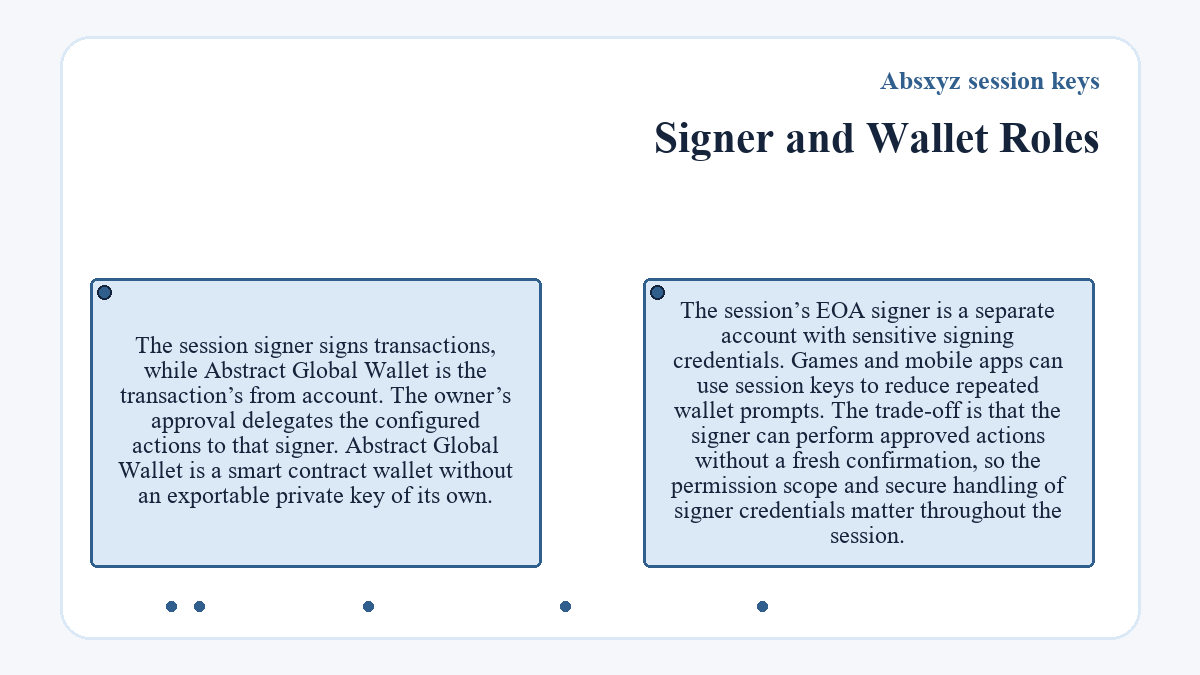
The session signer signs transactions, while Abstract Global Wallet is the transaction’s
from
account. The owner’s approval delegates the configured actions to that signer.
Abstract Global Wallet is a smart contract wallet without an exportable private key of its own. The session’s EOA signer is a separate account with sensitive signing credentials.
Games and mobile apps can use session keys to reduce repeated wallet prompts. The trade-off is that the signer can perform approved actions without a fresh confirmation, so the permission scope and secure handling of signer credentials matter throughout the session.
First Session Setup
-
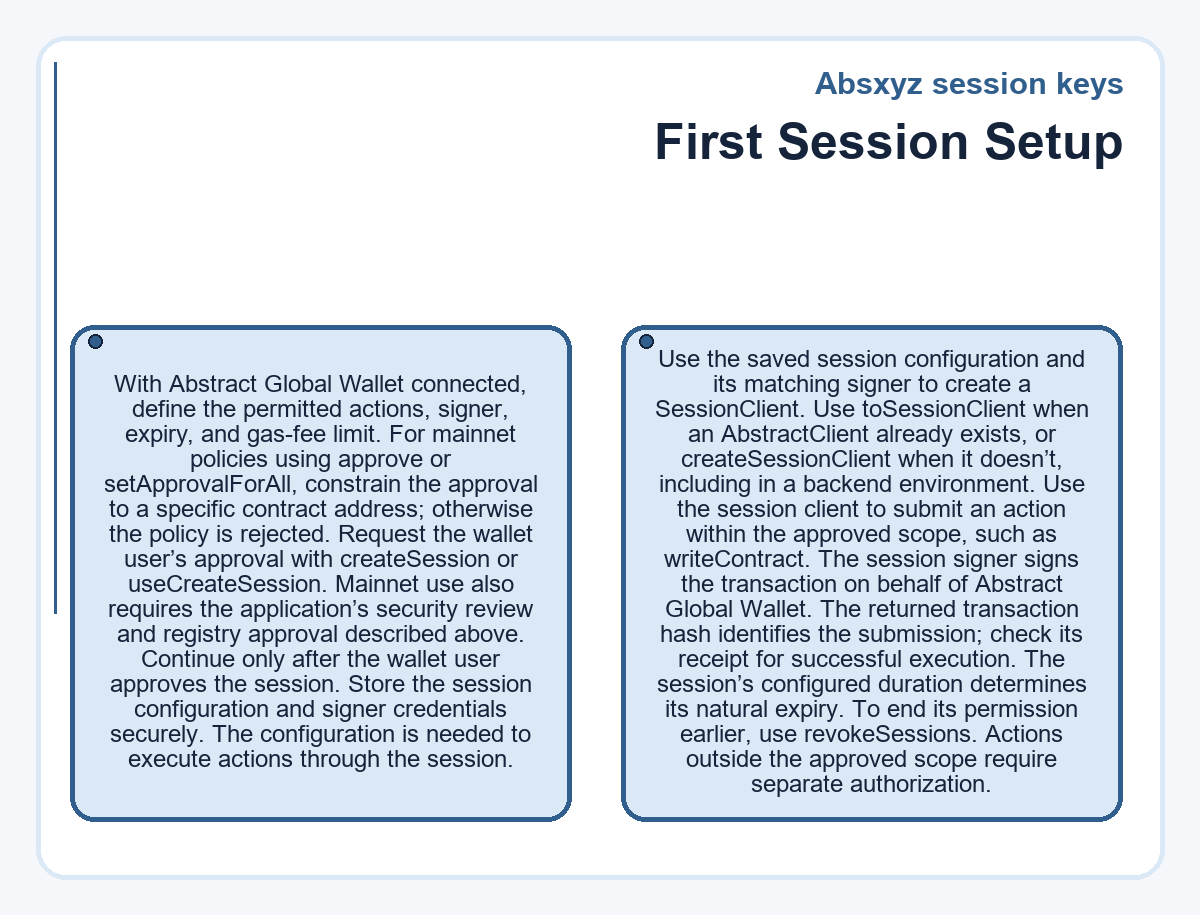
With Abstract Global Wallet connected, define the permitted actions, signer, expiry, and gas-fee limit. For mainnet policies using approve or setApprovalForAll, constrain the approval to a specific contract address; otherwise the policy is rejected. Request the wallet user’s approval with
createSessionoruseCreateSession. Mainnet use also requires the application’s security review and registry approval described above. Continue only after the wallet user approves the session. - Store the session configuration and signer credentials securely. The configuration is needed to execute actions through the session.
-
Use the saved session configuration and its matching signer to create a
SessionClient. UsetoSessionClientwhen anAbstractClientalready exists, orcreateSessionClientwhen it doesn’t, including in a backend environment. -
Use the session client to submit an action within the approved scope, such as
writeContract. The session signer signs the transaction on behalf of Abstract Global Wallet. The returned transaction hash identifies the submission; check its receipt for successful execution.
The session’s configured duration determines its natural expiry. To end its permission earlier, use
revokeSessions
. Actions outside the approved scope require separate authorization.
Permission Limits During Wind-Down
Executing an action through a session requires the relevant contracts, network, and any application services it uses to be available. Cube, Inc.’s Terms of Service updated October 6, 2026 explain that authentication, signing, and other services may end at different times during Abstract’s wind-down. Individual exit routes may also have initiation, completion, or claim deadlines earlier than chain discontinuation.
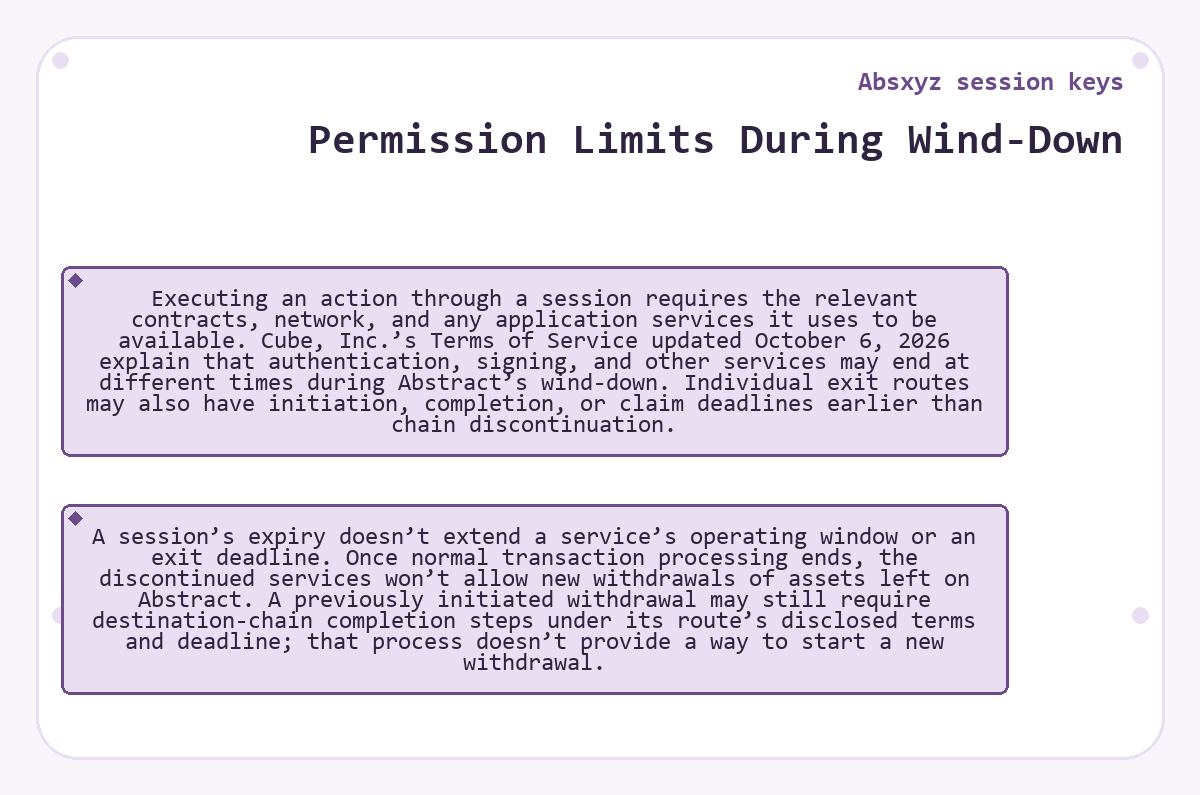
A session’s expiry doesn’t extend a service’s operating window or an exit deadline. Once normal transaction processing ends, the discontinued services won’t allow new withdrawals of assets left on Abstract. A previously initiated withdrawal may still require destination-chain completion steps under its route’s disclosed terms and deadline; that process doesn’t provide a way to start a new withdrawal.